
TokenPost.ai
Crypto markets traded mixed on Wednesday UTC, with Bitcoin (BTC) holding a modest gain while Ethereum (ETH) outperformed—signaling a tentative rotation toward large-cap altcoins even as overall activity cooled across DeFi, stablecoins, and derivatives.
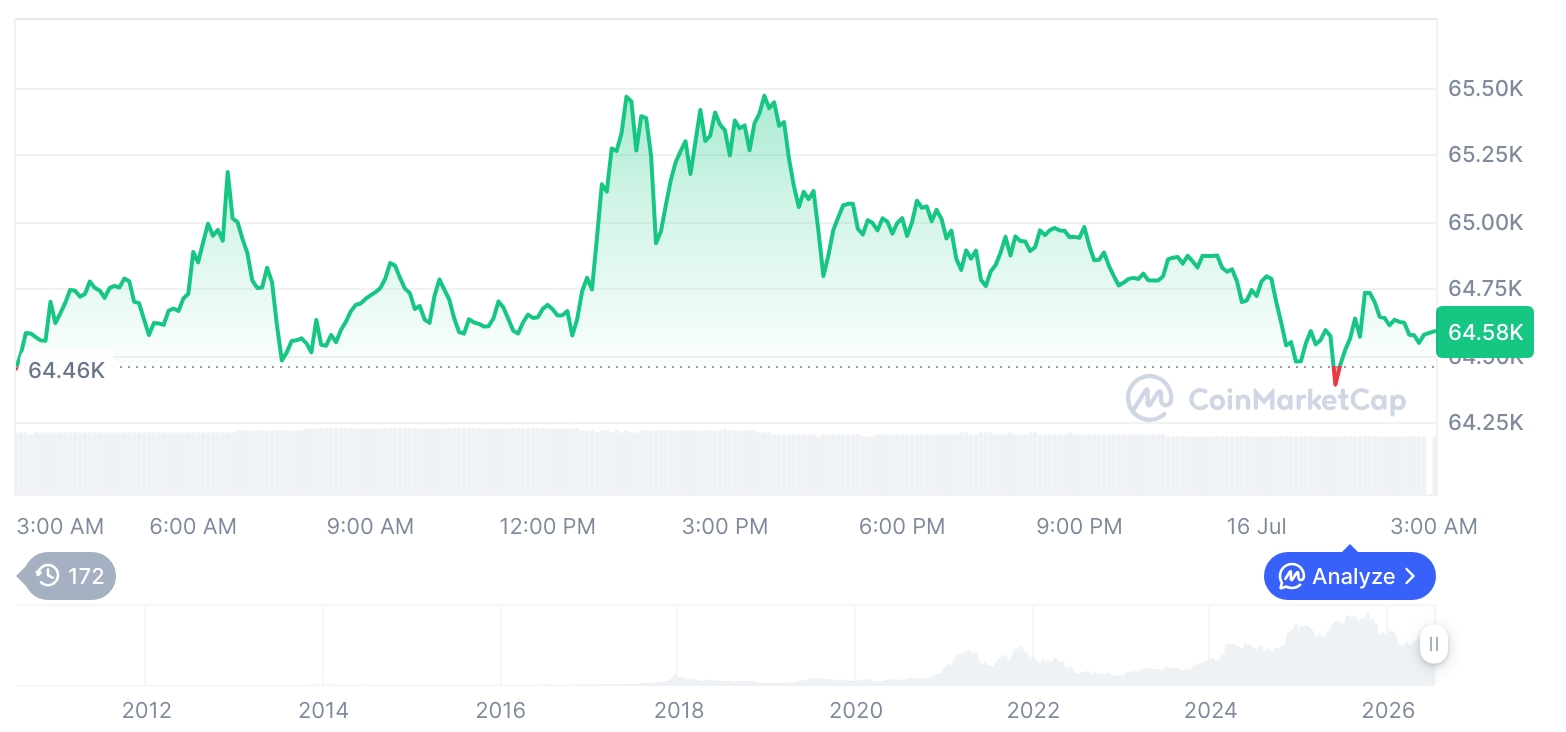
According to TokenPost Market data timestamped at 03:07 UTC on July 16, Bitcoin rose 0.18% over the previous day to $64,588.87. Ethereum advanced 3.17% to $1,923.53, posting a stronger daily move than BTC and helping lift ETH’s share of total crypto market value.
Price action among major altcoins was uneven. XRP (XRP) gained 1.54%, BNB (BNB) added 0.03%, and Dogecoin (DOGE) rose 0.81%, while Solana (SOL) slipped 0.23% and Tron (TRX) fell 0.29%. Hyperliquid (HYPE) edged up 0.20%.
In aggregate, altcoins (excluding Bitcoin) accounted for roughly $927.12 billion in market capitalization, with $39.87 billion in 24-hour trading volume. The broader crypto market was valued at about $2.22 trillion, with total 24-hour spot volume estimated at $67.29 billion—figures that point to steady pricing but a less aggressive risk posture from traders.
Market 'dominance' metrics underscored that divergence. Bitcoin dominance dipped to 58.29%, down 0.17 percentage points from the prior day, while Ethereum dominance climbed to 10.44%, up 0.27 percentage points. The combination of a slight BTC share decline and a rising ETH share is often interpreted as early-stage 'capital rotation' within large-cap assets rather than a broad-based altcoin surge.
Elsewhere, on-chain and liquidity-sensitive segments softened. The DeFi market was valued at $67.58 billion, while DeFi trading volume over the past 24 hours totaled $8.57 billion, down 6.22%. Stablecoins—often used as a proxy for market liquidity and positioning—held a combined market capitalization of $281.87 billion, but 24-hour volume fell 7.18% to $69.42 billion.
Derivatives activity also cooled notably, suggesting reduced leverage appetite. Total crypto derivatives—futures and options—logged $732.09 billion in 24-hour volume, a 19.20% decline from the previous day. While falling derivatives turnover can reflect healthier, less speculative price action, it can also signal waning momentum and a higher likelihood of range-bound trading when spot demand is not accelerating.
Overall, the session showcased a market willing to bid up Ethereum alongside a steady Bitcoin, but not yet backed by expanding volumes across DeFi, stablecoins, or leveraged instruments. That mix leaves the near-term tone cautiously constructive, with investors watching whether ETH’s relative strength develops into a broader shift in risk appetite—or fades as activity indicators remain subdued.
Article Summary by TokenPost.ai
🔎 Market Interpretation
- Mixed session with large-cap divergence: BTC held near-flat gains (+0.18% to $64,588.87) while ETH showed clear relative strength (+3.17% to $1,923.53), indicating selective risk-taking rather than broad market expansion.
- Early rotation signal (not a full altseason): Bitcoin dominance slipped to 58.29% (-0.17pp) while Ethereum dominance rose to 10.44% (+0.27pp). This pattern more closely resembles capital rotating within large caps than a widespread move into smaller altcoins.
- Altcoin performance uneven: Gains in XRP (+1.54%), DOGE (+0.81%), and minor upticks in BNB (+0.03%) contrasted with dips in SOL (-0.23%) and TRX (-0.29%), reinforcing that the bid was concentrated rather than market-wide.
- Price stability vs. activity slowdown: Total market cap near $2.22T with spot volume around $67.29B suggests steady pricing, but cooling participation implies traders are less aggressive about adding risk at current levels.
- Liquidity and leverage indicators softened: DeFi volume fell 6.22% to $8.57B, stablecoin volume fell 7.18% to $69.42B, and derivatives volume dropped sharply 19.20% to $732.09B—consistent with reduced leverage appetite and potentially more range-bound conditions.
💡 Strategic Points
- Watch ETH continuation vs. confirmation: ETH outperformance can persist if follow-through appears in spot volume and improving breadth across majors; without that, it risks being a short-lived relative-strength burst.
- Use dominance as a regime filter: A continued ETH dominance rise alongside stable/declining BTC dominance often aligns with a “large-cap rotation” phase; a broader alt rally typically requires more pronounced BTC dominance erosion plus improving volume participation.
- Favor selective exposure over broad baskets: Given uneven alt performance and declining activity metrics, strategies may lean toward quality/large-cap positioning and tighter risk controls rather than indiscriminate altcoin beta.
- Derivatives drop suggests lower momentum: Falling derivatives turnover can mean healthier, less speculative flows, but also signals reduced momentum. Traders may expect more range trading until spot demand or liquidity metrics re-accelerate.
- Liquidity proxy check (stablecoins): If stablecoin volumes keep declining, it may indicate less fresh capital and positioning; an upturn would strengthen the case that ETH-led strength is being funded by broader participation.
📘 Glossary
- Dominance (BTC/ETH dominance): The percentage share of total crypto market capitalization attributed to Bitcoin or Ethereum; used to gauge where capital concentration is increasing or decreasing.
- Capital rotation: A shift of investor capital from one segment (e.g., BTC) to another (e.g., ETH or large-cap alts), often preceding broader risk-on behavior but not guaranteeing it.
- Large-cap altcoins: Non-Bitcoin cryptocurrencies with high market capitalization (e.g., ETH, BNB, XRP), often viewed as the first beneficiaries when investors move beyond BTC.
- Spot volume: Trading volume in the actual asset market (not leveraged contracts), commonly interpreted as more “real” demand than derivatives-only activity.
- DeFi (Decentralized Finance): On-chain financial services (lending, exchanges, derivatives) run by smart contracts rather than centralized intermediaries.
- Stablecoins: Tokens designed to track fiat value (typically USD); their market cap and volume are often used as a proxy for crypto liquidity and risk positioning.
- Derivatives volume: The amount traded in futures/options; higher levels often imply greater leverage and speculative activity, while declines can point to reduced leverage appetite.
- Range-bound trading: A market state where prices move within a relatively stable band, often emerging when participation and momentum indicators weaken.